What this number is
Mass over volume.
The labeled milligrams on the vial divided by the milliliters of solvent you add. Units are mg/mL. It is the working concentration of that solution on the bench.
Laboratory notes
These pages teach the documents that travel with a research vial: a chromatogram, a mass spectrum, and a certificate of analysis. They are laboratory documents, not lifestyle outcomes.
Nothing here is a result for a BioFirst lot. Peak-area figures, observed masses, and lab names live on the certificate that matches the vial in your hand.
Key takeaways
Bench arithmetic
Labeled milligrams on the vial, divided by milliliters of solvent added. Live math only. It does not use HPLC %, body weight, or a protocol.
5.00 mg/mL
10 mg labeled ÷ 2 mL solvent
Bench concentration for in-vitro work. Not a dose. Not for human use.
The labeled milligrams on the vial divided by the milliliters of solvent you add. Units are mg/mL. It is the working concentration of that solution on the bench.
It is not a human dose, not IU, not an injection volume, and not net peptide content. It does not use HPLC area % and it does not invent a BioFirst fill weight.
In-vitro work needs a stated concentration so later dilutions are reproducible. Identity and purity still live on the lot COA, not in this box.
01 · How to read a trace
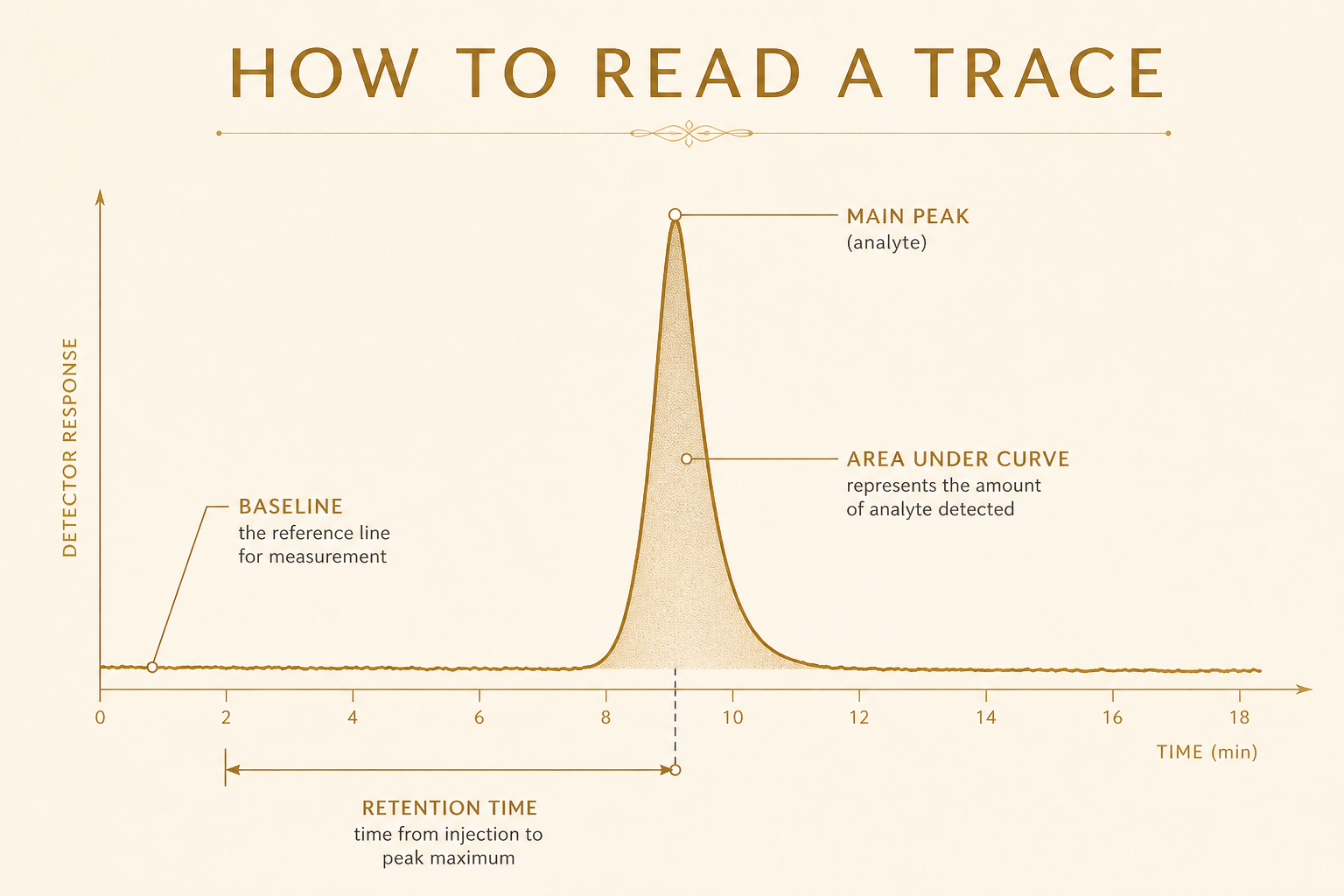
The detector’s signal when only mobile phase is flowing. A stable baseline is what lets a peak be integrated. Drift or noise belongs in the method notes, not in a marketing bar.
Each UV-active species leaves the column at a characteristic time under a stated method. Retention time is method-dependent. It is not an identity by itself.
The dominant peak is usually assigned to the listed compound — after identity work, not instead of it. Extra peaks are other UV-active species at that wavelength.
HPLC purity, as commonly reported, is main-peak area divided by the total detected peak area at a stated wavelength. It is an area ratio, not a weighing of the vial.
Write it as a formula, because that is all it is:
HPLC purity = (main-peak area) ÷ (sum of detected peak areas) at a stated λ
Extra peaks are other species the detector can see at that wavelength. They may be related peptides, residual protecting groups, or process impurities. They are not automatically “inactive” or “dangerous.” They are other UV-active species.
Salts, TFA, and water are often invisible at 214 nm. A high HPLC area % can sit on a vial that still contains counter-ion and residual moisture. HPLC % is not net peptide content. Net peptide is a different measurement, usually by nitrogen or amino-acid analysis, and it belongs on the certificate if it was run.
A homepage that prints a purity number without a lot, a wavelength, and a method is not teaching you how to read a lot. It is decorating.
02 · Two questions
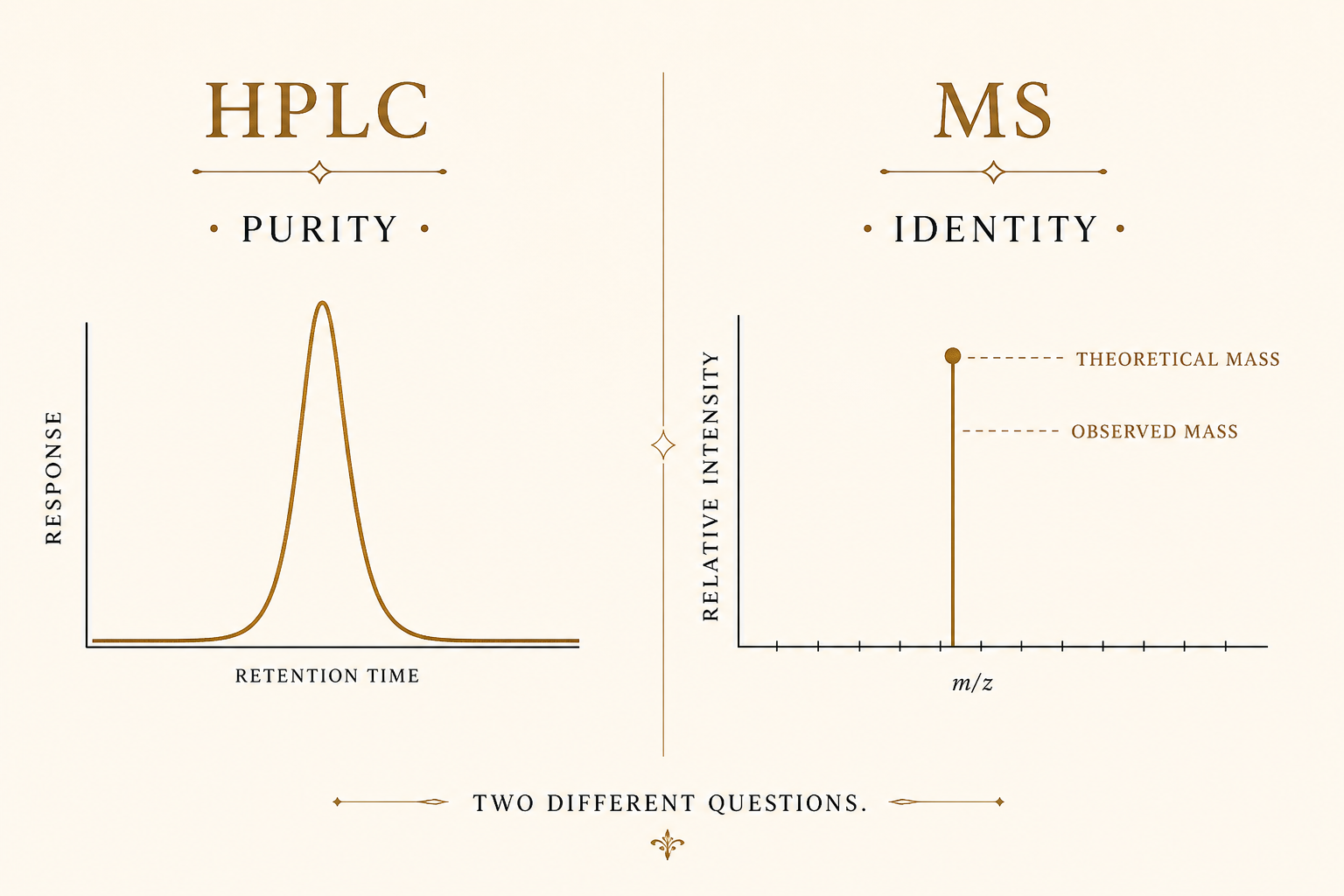
A serious lot answers two different questions.
What fraction of the UV-active material is the main peak? That is HPLC (or an equivalent chromatographic purity method). It does not name the molecule.
Is the main species the listed compound? That is mass spectrometry: expected mass from the public formula versus observed mass on the certificate. A match supports identity. A mismatch is a problem no area % can paper over.
HPLC ≠ identity. Purity of the wrong molecule is still the wrong molecule. A 99-point number on a mis-assigned peak is a precise wrong answer.
Expected mass comes from the public molecular formula (and the ionization mode the lab used). Observed mass comes from the instrument. Both fields should appear on the COA. This site will not invent an observed mass for a BioFirst lot.
03 · Five fields on a COA
A certificate of analysis is a laboratory record for one lot. Learn the five fields that make it usable. We will not print fictional BioFirst lot numbers, lab names, or percentages here.
The identifier that also appears on the vial. If the PDF and the label do not share a lot, you do not have a matched record.
Test date or report date. A sheet with no year, or a year that never moves, is not a living record.
Who ran the work. A certificate without a laboratory is a brochure with a table.
HPLC column and wavelength, MS mode, residual-solvent method. A bare “99%” with no method is not HPLC purity. It is a number with nowhere to sit.
The trace, or a table of retention times and area %. Without one of those, you cannot see what was integrated.
How to spot a weak COA, in any catalog:
04 · Crude vs net
Illustration only. Segment lengths are teaching marks, not BioFirst measurements. No HPLC % or net-peptide figure is claimed for any SKU on this page.
Lyophilized peptide is rarely “all peptide.” Counter-ions (often TFA or acetate) and residual water take mass. HPLC at 214 nm frequently does not see them.
That is why two honest numbers can live on one certificate: an HPLC area % for the main UV peak, and a net peptide content for the fraction of weighed mass that is peptide. They answer different questions. Collapsing them into one homepage percentage hides the difference.
If a vendor prints only HPLC % and calls it “purity of the vial,” they are mixing a chromatogram with a balance.
05 · Identity sheets
Literature identifiers only. Empty cells stay empty. Sequences marked “commonly published” are catalog identity, not a measured assay on a BioFirst lot.
Public chemistry for the single. Lot identity is the COA’s observed mass, not this card.
Open the SKU →A cofactor, not a peptide chain. Do not read it as if it had a primary sequence.
Open the SKU →The sequence is a commonly published fragment identity for this name. It is not a lot result and not an assay we ran on this page.
Open the SKU →Listed in the catalog as part of the BPC-157 / TB-500 two-compound SKU. We will not invent a molecular weight or a purity for the blend here.
Open the blend SKU →~711.4 Da is public chemistry for Ipamorelin as a single. It is not a blend mass and not a lot observation.
Open the SKU →A botanical phospholipid complex. There is no peptide sequence to print, and we will not invent one.
Open the SKU →06 · Price bars
These are the listed prices. The bars are not a ranking of quality, purity, or identity.
AOD-9604 $95 · BPC-157 $110 · NAD+ $120 · Curcumin Phytosome $140 · Tesamorelin / Ipamorelin $155 · BPC-157 / TB-500 Blend $185. Catalog prices, not a quality ranking.
07 · FAQ
Research Use Only. These materials are sold for in-vitro and laboratory research. They are not approved medicines, not supplements, and not for human consumption, self-administration, or therapeutic use.
No. BioFirst does not provide dosing, body-weight charts, injection instructions, or treatment advice. Reconstitution language on the site is bench arithmetic (mg/mL) for laboratory work.
Because HPLC and MS answer different questions. Chromatography reports how the UV-active peak area splits. Mass spectrometry checks whether the species matches the expected mass of the listed compound. One without the other is half a record.
A percentage without a lot, a method, and a wavelength is not a result. Numbers live on the COA for that lot. Putting a decorative 99 on the homepage would be the cheap version of this page.
A manufacturing batch. The lot identifier on the vial should match the lot on the certificate. Different lots of the same SKU are different records.
Temperature-sensitive compounds ship with cold-chain packaging so the vial is not treated like ambient shelf stock. It is a fulfilment method, not a stability claim for a named lot.
References
General chemistry and catalog facts. No invented papers, HPLC percentages, or BioFirst lot results.
Disclaimer. Not FDA approved. For research purposes only. Not intended for human consumption, self-administration, or therapeutic use. All products sold for in vitro and laboratory research use only. Traces, charts, and stacked bars on this page are illustrations. They are not certificates and not lot results. Public sequences and molecular weights are literature identity for the named compound. They are not evidence of a completed assay on a BioFirst batch.
Your cart is empty.